

“Don’t take the casual approach to life. Casualness leads to casualties.” – Jim Rohn
After a difficult first quarter in which equity and debt markets suffered losses, investor sentiment recovered and animal spirits reawakened. Global equity markets rallied 14% in the second quarter. While some relief on the Iran War may have sparked the fire, excitement about Artificial Intelligence (AI) is what spread and sustained it. In fact, just 15 technology companies accounted for 10% of the S&P 500’s 15% return in the second quarter. There were 21 technology companies in the S&P 500 that gained over 50% during the quarter.1
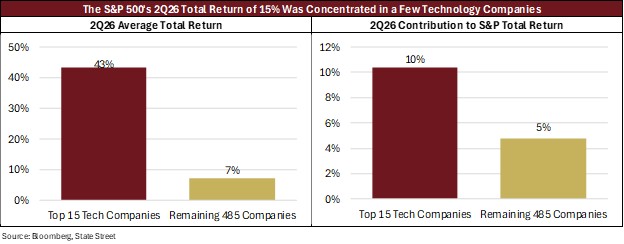
As value investors, the rationalist in us wants to question how such a narrow group of technology companies could generate the vast majority of the market’s gains and whether their valuations are justified by underlying fundamentals. The reality is that large, complex systems of Technology are changing extremely rapidly via AI. A fantastic example of how fast things are transforming is the demand for memory semiconductor chips—the widgets that help computers store information and access that information efficiently. Just a few short years ago, the memory chip industry was in a massive inventory glut with supply heavily outweighing demand. However, with the advent of AI and its need to access vast amounts of data with exceptional speed and precision, the demand for storage and memory has not only multiplied, but the complexity of the need has also dramatically intensified. As a result, standard memory chips, called Dynamic Random Access Memory (DRAM), are not adequate to complete the tasks needed for AI to function properly. In response, a few chipmakers have designed High Bandwidth Memory (HBM) chips. To provide an analogy, standard DRAM is like a two-lane road. HBM is not just a road with more lanes—it is more like a stacked, multi-level, multi-lane highway that can move 10 to 20 times more traffic at once. Essentially, HBM provides 10 to 20 times more bandwidth than the “old” standard from a few short years ago.
There are only three companies in the world designing and manufacturing these in high-demand HBM chips. One such company, Micron, has seen its revenue jump from $15.5 bn during the glut year of 2023 to $58 bn in the trailing twelve months. It has more than tripled its business in very short order, but what is more shocking perhaps are the expectations that revenue is anticipated to jump another ~4x to nearly $250 bn by 2027. While the stock price has jumped by ~800% in the last two years, Micron’s earnings are also projected to expand by ~1000% from 2025 to 2027. Thus, despite the parabolic move in the stock price, Micron trades with a Price-to-Earnings multiple of 8x (in contrast to the 22x average of the S&P500.)1 While future growth is not guaranteed, Micron’s price action and valuation appear quite rational.
However, no matter how logical that may seem, these types of sharp rallies can feel uncomfortable and almost too good to be true. That’s probably because the last time things were changing this fast in Technology was the late 90s. Most of our clients can recall when the Nasdaq (heavily biased towards Technology) skyrocketed ~220% from 1998 to early 2000 on excitement about the potential of the Internet Boom. Unfortunately, reality set in, and the Nasdaq subsequently crashed more than 70%, erasing all the gains in an even shorter 18-month period. That market crash was painful, and so we understand the skepticism and angst from some about this cycle’s rally.
While a great proportion of the current investment sentiment does feel rational, there is certainly a level that feels illogical. The dot-com bubble was defined by investors speculating on lofty promises of future earnings, and there are clear signs that investors are yet again doing the same.
Despite a free cash flow burn-rate of $14 bn last year, SpaceX recorded the largest IPO in history during the second quarter. At one point, it was valued at over $2.6 tn, making it the fifth largest company in the world (ahead of the likes of Amazon and Meta Platforms). To provide some further perspective, the aforementioned Micron has three times the actual (not projected) revenue, yet only half the market valuation of SpaceX.1 While SpaceX may come good on its promises, there is a level of FOMO (Fear-Of-Missing-Out) in the market that is palpable. The FOMO doesn’t just exist on one company but feels quite prolific. To be clear, we are not suggesting that this market cycle is a replay of the dot-com bubble, but there are aspects of today’s environment that do bear some resemblance.
So, it is our job to not be casual, not be nonchalant, not be “fat and happy” with the returns of the past few years. Rather it is to resist the FOMO—to be disciplined and discerning with our clients’ investment capital. As the late-great motivational speaker Jim Rohn preached, “Casualness leads to casualties.” To avoid casualties, we must ensure the risk of the portfolio is aligned with the risk tolerance of the client. That always starts with asset allocation but includes a variety of other factors including security selection and position sizing. The fiduciary in us will persistently do our best to manage the risks, while the optimist in us continuously searches for new ways to profit from the potential of these new technologies.
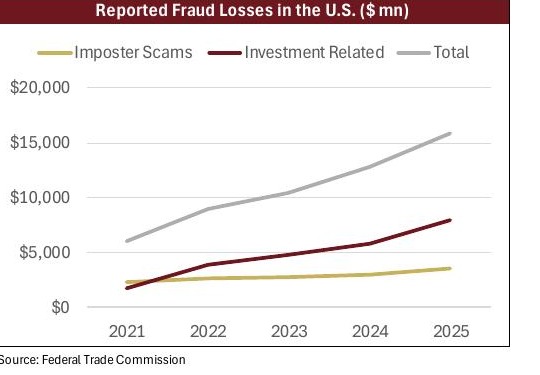
As fiduciaries, it is also our job to protect (and in most cases grow) your capital—not just from market downturns, but other threats too. Some of those threats are as old as time, including taxes, fees, overspending and inflation. Others, however, are newer and much more complex. Fraud via the use of technology (wire fraud, phishing, etc.) is on top of our minds. According to the Federal Trade Commission, financial losses due to fraud in the U.S. increased 25% last year and hit an all-time high of $16 bn.2 With AI, the fraudsters are clearly becoming more sophisticated. The good news is that protections against these threats are also improving. A simple, yet effective tool that can help deter fraudulent activity is establishing two-factor authentication at your custodian log in. There are other tools as well to protect your investment account(s). If you need help establishing two-factor authentication or would like to discuss additional safety measures, please don’t hesitate to contact us. Let’s not be casual with your security; instead let’s protect those hard-earned assets from avoidable casualties.
1 Bloomberg L.P. “Company Financial Filings.” Accessed 26 June 2026.
2 Federal Trade Commission. “FTC Data Show People Reported Losing $3.5 Billion to Imposter Scams in 2025 | Federal Trade Commission.” Federal Trade Commission , 15 June 2026, www.ftc.gov/news-events/news/press-releases/2026/06/ftc-data-show-people-reported-losing-3-point-5-billion-imposter-scams-2025.
The views expressed in this material are the views of Naples Global Advisors, LLC through 6/30/2026. The views are subject to change based on market and other conditions. All information has been obtained from sources believed to be reliable, but its accuracy is not guaranteed. There is no warranty as to the current accuracy, reliability or completeness of, nor liability for, decisions based on such information. This document contains certain statements that may be deemed forward-looking statements. Please note that any such statements are not guarantees of any future performance and actual results or developments may differ materially from those projected. This is not an offer or solicitation for the purchase or sale of any security and should not be construed as such. The information provided is for illustrative purposes only and is not intended to be, and should not be interpreted as, recommendations to purchase or sell securities. Naples Global Advisors, LLC is governed under the Securities and Exchange Commission as an Investment Advisor under the Investment Advisors Act of 1940. All investments contain risk and may lose value.