

“The single greatest edge an investor can have is a long-term orientation.” – Seth Klarman, founder of Baupost Group and author of Margin of Safety
A resilient portfolio is more than a collection of good investments, especially when they share the same risks. Each position should play a distinct role.
High-quality bonds and money markets provide stability. Easy to overlook during periods of euphoria, they become valuable when volatility surfaces and protecting principal matters most. Think of it like a football team: not every player is on the field to make highlight-reel plays. Some protect the ones who do. Bonds and cash are the “big uglies,” quietly holding the line and giving the portfolio time and cover to take the risks growth requires. A well-built portfolio accounts for each asset class’ risks. Not every holding needs to be the star. What matters is that each plays its role well.
Established businesses committed to their dividends deliver recurring, predictable cash flow. For capital appreciation potential, growth-oriented equities are our running backs and wide receivers. International and emerging markets introduce geographic diversification and exposure to different economic cycles. These segments are akin to special teams, with many equities trading at lower valuation multiples than parts of the S&P 500. They also add currency exposure, which does not move in lockstep with U.S. equity risk.
The point of this mix is not diversification for its own sake. It is to give compounding the best chance to work in our clients’ favor. The journey matters: a 50% loss requires a 100% gain to break even, and the deeper the loss, the harder the recovery. By constructing portfolios with complementary return drivers, we aim to lessen downside volatility, allowing your assets to compound across market cycles.
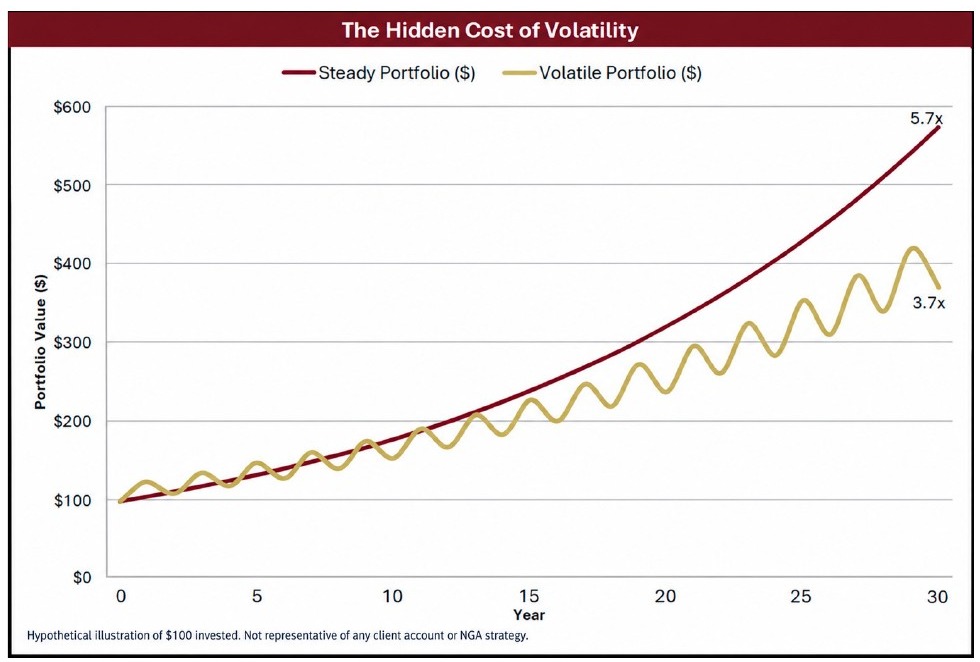
The chart above illustrates this concept, comparing a steady 6% annual return to a boom-bust cycle of +24% followed by -12%. Over 30 years, both portfolios produce an arithmetic average return of 6% per year. Yet the ending results tell a different story. The steady portfolio grows to roughly 5.7 times the initial investment, versus 3.7 times for the volatile one. Once portfolio distributions enter the picture, the gap widens further, as selling during a drawdown permanently impairs recovery. Two portfolios with identical average returns can produce noticeably different outcomes depending on the path.
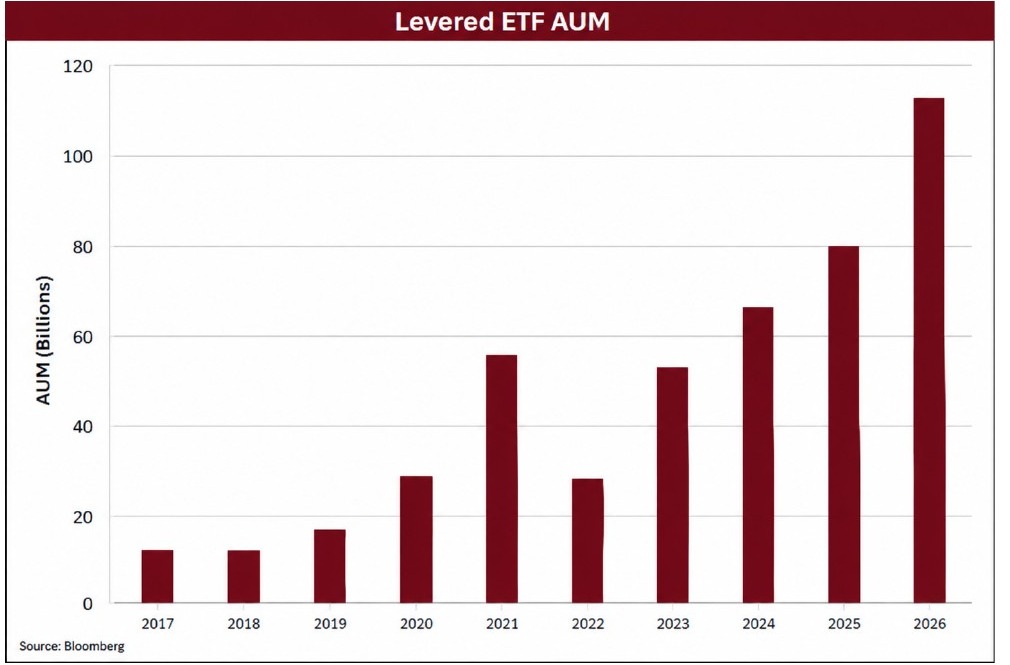
This philosophy also shapes how we view products investors use to pursue returns. Leveraged exchange-traded funds (ETFs) are an example of how the structure of an investment can matter as much as the underlying exposure. These funds aim to deliver two or three times the daily return of an index. Used for tactical trades, they can serve a legitimate purpose. The trouble starts when a trading instrument is treated like a long-term investment. These funds can amplify losses as quickly as they amplify gains, magnifying the volatility drag previously illustrated. According to Bloomberg, assets under management (AUM) in index-based leveraged ETFs have grown from roughly $8 billion in 2016 to $112 billion today.1 As Charlie Munger observed, “Someone will always be getting richer faster than you. This is no great tragedy.” But watching someone else get rich quickly can make patience feel like failure.
We see the same dynamic in single-stock leveraged ETFs tied to companies at the center of the artificial intelligence (AI) infrastructure buildout.2 In client portfolios, we own several of the underlying businesses directly rather than the speculative vehicles built around them.
Not all of technology, however, is priced for AI-driven growth. We continue to find value within out-of-favor software subsectors, particularly companies that operate as systems of record, storing the information a business cannot run without, rather than serving as an interface layer on another provider’s infrastructure. Recent partnerships between leading AI developers and enterprise software providers bring AI models directly to core databases rather than replace them. Matching features is not the same as earning a customer’s trust with critical data or replicating the deep integration into proprietary systems.
Beyond technology, opportunities persist in areas the AI boom has overshadowed, including capital-light financial services. We are evaluating financial infrastructure providers and exchanges, data and analytics providers, and asset managers. These companies have pricing power, require comparatively little capital to grow, and generate free cash flow. For some, we believe the market is pricing in more AI-related uncertainty than their competitive advantages warrant, leaving valuations that offer a long-term margin of safety.
We remain focused on identifying enduring companies with sustainable competitive advantages. Ongoing geopolitical tensions, monetary policy, and the massive capital investments funding the AI buildout dominate the conversation, but our process remains the same. A company earns a place in your portfolio because we believe its long-term value exceeds its price, not because it is getting media attention. That process recently took our team to Germany and Switzerland, where we met with management teams at companies that reflect these qualities. You’ll hear more about our team’s observations in a separate report.
Closer to home, we’re pleased to welcome Mackenzie Falduto as an Investment Analyst, strengthening the research team behind your portfolio. We are settled into our new office and look forward to hosting you on your next visit. We’re also excited to unveil our redesigned website at naplesglobaladvisors.com, and we encourage you to explore it.
1 Bloomberg LP. Data as of 22 Sept. 2026.
2 Zweig, Jason. “You’re Not Tough Enough to Earn These Huge Returns.” The Wall Street Journal, 4 Sept. 2026, www.wsj.com/finance/investing/youre-not-tough-enough-to-earn-these-huge-returns-3feaad7b.
The views expressed in this material are the views of Naples Global Advisors, LLC through 9/30/2026. The views are subject to change based on market and other conditions. All information has been obtained from sources believed to be reliable, but its accuracy is not guaranteed. There is no warranty as to the current accuracy, reliability or completeness of, nor liability for, decisions based on such information. This document contains certain statements that may be deemed forward-looking statements. Please note that any such statements are not guarantees of any future performance and actual results or developments may differ materially from those projected. This is not an offer or solicitation for the purchase or sale of any security and should not be construed as such. The information provided is for illustrative purposes only and is not intended to be, and should not be interpreted as, recommendations to purchase or sell securities. Naples Global Advisors, LLC is governed under the Securities and Exchange Commission as an Investment Advisor under the Investment Advisors Act of 1940. All investments contain risk and may lose value.